

Money Moves: Accessible High School Lessons for National Financial Literacy Month
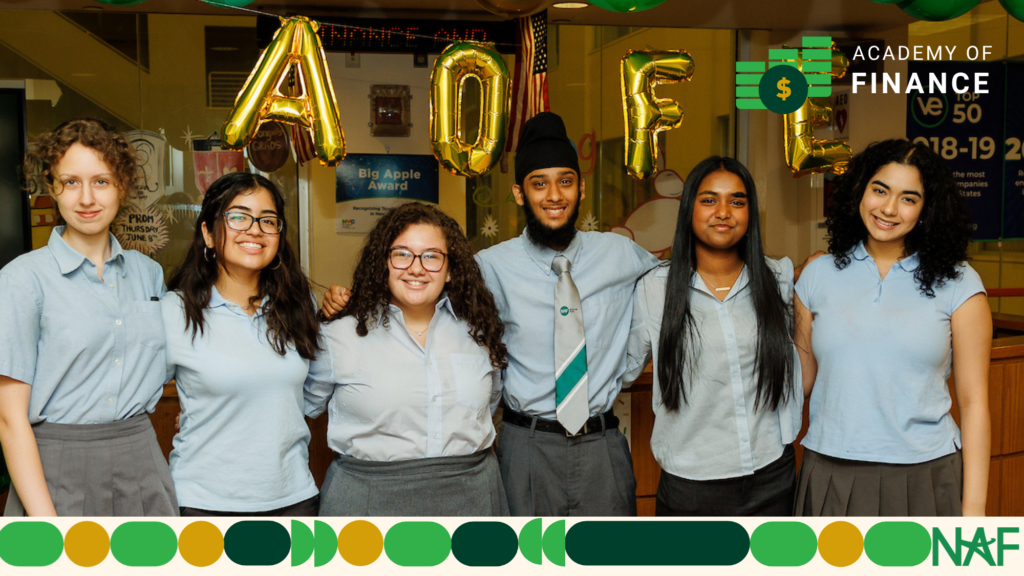
NAF students are making waves in the sphere of finance and there’s no better time to highlight what makes the Academy of Finance pathway stand out than National Financial Literacy Month that runs throughout April.
For educators nationwide April is as good a time as any to tap into financial literacy resources, and integrate valuable lessons into the classroom. Most teenagers don’t learn about money in school, and a majority of American adults wish the opposite were true. The National Endowment for Financial Education found that 83% of surveyed American adults support requiring personal finance courses in high school. Financial literacy is not just a nice-to-have, for Americans who don’t grow up with a robust personal finance understanding in their home, it points to an opportunity for growth in achieving long-term stability.
Unlike the average high school student, understanding what a 401(k) is and the difference between a savings account and a high-yield one are part of the NAF Finance curriculum along with graduated business concepts like marketing and leadership, so Academy of Finance students leave with financial savvy and the career readiness for the finance careers of tomorrow.
For students across the NAF pathways (and in public schools nationwide), teaching financial literacy in high school can enhance their pathway experience and better equip them to navigate the challenges of paying for post-secondary education and prepare to build capital as young adults.
Here are five lessons that meet teens where they are and offer them tools that fit their lives:
1. Cell Phone Plans: A Real-World Comparison
The big idea: Not all bills are created equal — and reading the fine print matters.
This is one of the most engaging financial literacy lesson plans you can bring into the classroom — because it’s highly likely that students either have a phone plan or intend to get one in the near future. Pull up 3–4 real cell phone plans (prepaid vs. postpaid, major carrier vs. budget carrier) and have students compare them side by side:
- Monthly cost
- Data limits and overage fees
- Contract requirements
- Hidden fees (taxes, activation, insurance)
Ask: Which plan gives you the most value for the money? Which one looks inexpensive but isn’t? This exercise doubles as a lesson in reading contracts and understanding that advertised prices rarely tell the whole story.
Key takeaway: Being a smart consumer means asking questions before you sign anything.
2. Understanding Your First Paycheck
The big idea: Gross pay and net pay are not the same thing — and that’s okay once you understand why.
Nothing is more confusing — or deflating — than getting your first paycheck and realizing it’s smaller than expected. This is a cornerstone of any honest personal finance curriculum for high school, and it’s one area where teaching financial literacy in high school can have an immediate, real-world impact. Walk students through a sample pay stub line by line:
- Gross pay vs. net pay
- Federal and state income tax withholding
- FICA (Social Security and Medicare)
- Any voluntary deductions (health insurance, 401k if applicable)
Then introduce the concept of W-4 withholding and what it means to get a tax refund vs. owe money at tax time. Keep it simple, but make it real.
Key takeaway: Understanding your paycheck is the first step to controlling your money — not the other way around.
3. The Magic (and Math) of Compound Interest
The big idea: Your money can work for you — but so can debt.
Compound interest boils down to relatively simple math, but impacts a range of real-world situations from student loan repayment to investing for retirement. Use a simple example: if you save $25 a month starting at 16, you’ll have dramatically more at 65 than someone who starts at 30 saving the same amount. Let students run the numbers themselves using a free compound interest calculator — one of the easiest financial literacy resources to find online.
Then flip it: show them how compound interest works against them on credit card debt. A $500 balance at 24% APR, paid off slowly, can cost nearly double over time.
Key takeaway: Time is your biggest financial asset. Save and invest early, even small amounts have a big long-term impact.
4. The Buying Plan for Big Purchases
The big idea: Wanting something and being ready to buy it are two different things.
Whether it’s sneakers, a laptop, or eventually a car — teens need a framework for big purchases. This is one of the most practical additions to any personal finance curriculum for high school because it connects directly to decisions students are already making. Walk them through a simple buying plan:
- What does it cost (total, including tax and fees)?
- How long will it take to save for it?
- Are there smarter alternatives (refurbished, secondhand, payment plans with no interest)?
- What am I giving up to buy this? (opportunity cost)
Role-play a scenario where two students want the same $300 item. One puts it on a credit card; one saves for 3 months. Who comes out ahead — and by how much?
Key takeaway: A plan turns a want into an achievable goal.
5. Your Savings First-Aid Kit
The big idea: Life happens. Be ready before it does.
An emergency fund isn’t just for adults. Even teens face unexpected costs — a broken phone, a lost transit card, a school supply emergency. This financial literacy lesson plan introduces the concept of a “Savings First Aid Kit”: a small, dedicated fund that exists only for true emergencies.
Help students set a starter goal ($50–$200) and identify one small way to build it — rounding up purchases, starting a dogwalking/babysitting gig, or setting aside $5 from every paycheck.
Bonus: Discuss where to keep it. A savings account separate from their checking account creates a small but meaningful safeguard against impulse spending.
Key takeaway: You don’t need a lot to start. You just need to start.
Next Steps: Finding Financial Literacy Resources for Your Classroom
You don’t have to build everything from scratch. Some of the best free financial literacy resources for high school teachers include:
- Everfi — A free financial literacy course for grades 9-12
- Next Gen Personal Finance (NGPF) — free, standards-aligned lesson plans and activities
- Consumer Financial Protection Bureau (CFPB) — tools and guides designed for educators
- Khan Academy — free personal finance modules students can work through independently
- Practical Money Skills — curriculum designed specifically for classroom use
- Part of NAF? Explore robust NAF curriculum resources via ASH. Not yet a NAF educator? Learn more about our full curriculum and how to join.
Together with the lesson frameworks above, these tools make building a comprehensive, semester-long personal finance curriculum straightforward and deeply rewarding. Financial literacy pays lifelong dividends — helping students and their families navigate an economy where the goalposts keep moving and milestones like homeownership, debt freedom, and retirement demand real strategy, not guesswork.
The classroom is where that strategy begins. Build the course they’ll carry with them long after graduation — the one they’ll thank you for.