

Meet the Educator Giving High School Students a Financial Head Start

For Jasmine Palmer-Gray, teaching finance isn’t just a job — it’s how she uplifts her community.
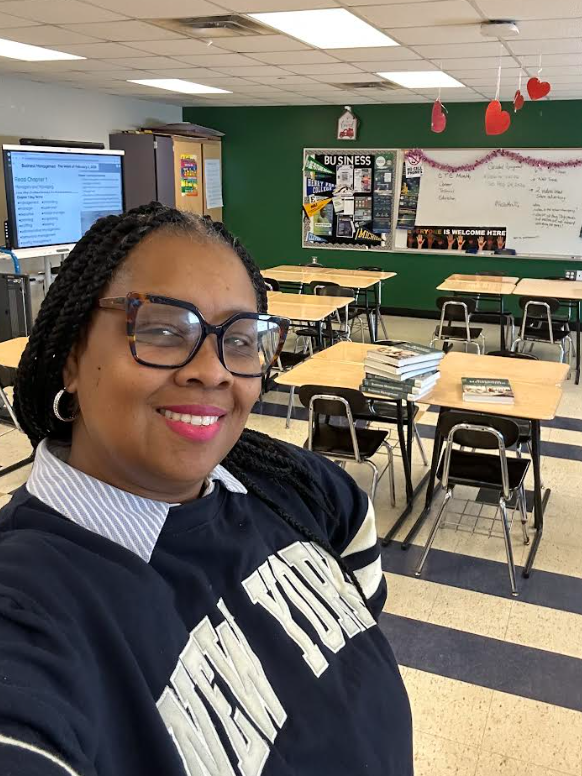
Born and raised in Detroit, MI, Palmer-Gray spent 20 years working in the banking industry before a friend convinced her to try substitute teaching. She never looked back. “I was hooked,” she says. “I was like, oh, I’m not going back.” Today she teaches in the same city that raised her, channeling two decades of real-world finance experience into the classroom every single day — and for her students at Southeastern High School’s NAF Academy of Finance in Detroit, that makes all the difference.
April is National Financial Literacy Month, and to celebrate, NAF offers an inside look at what it’s like to teach finance to eager young people in 2026, and how Jasmine Palmer-Gray found her path.
From Bank Auditor to Classroom Teacher
Palmer-Gray’s introduction to education was anything but conventional. With a degree in accounting and a professional background as both an internal and commercial bank auditor — plus experience within the mortgage side of banking — she had spent her entire career immersed in the world of numbers and money before discovering her love of teaching.
When she finally made the leap to teach at Southeastern, she found that the school had launched a NAF Academy of Finance pathway. She was then handed her first assignment — entrepreneurship and business management. “I grabbed one of the entrepreneurship curricula and that was my first curriculum I taught,” she recalls. “Going on the website just opened me up to so much information. I was hooked, and I wanted to learn everything else about NAF after that.”
A Finance Curriculum Built for Real Life
What makes Palmer-Gray’s classroom distinctive is the way her finance curriculum builds on itself year after year. In year one, students explore different careers and get an introduction to business basics and financial literacy. Year two dives deeper into business management and administration. By year three, students are putting it all into practice and focusing on leadership — some run the school store, others participate in their Career Technical Student Organization (CTSO) and take on real projects.
But perhaps what sets her classroom apart most is the access and exposure to real-world professionals they’d never encounter in a traditional math or English class. Realtors, entrepreneurs, bankers, doctors — Palmer-Gray brings in voices from across many industries, knowing that even students on a business pathway are prone to explore other areas, so making those connections early is all the more important.
“Whatever students are interested in, I try to make sure they have that actual connection with professionals,” she says. “Students also go out into the field through job shadows and worksite tours, and this spring they have a stock market challenge on the horizon alongside investing professionals in their community”.
The real proof, though, comes from the students who circle back. Alumni have returned to tell Mrs. Palmer-Gray that they used what they learned in her class to deposit a check through a mobile app for the first time, to understand how credit works, and to resist the temptation to open a stack of credit cards the moment they turn 18. “They come back and thank me for keeping them away from steep debt.”
Work-Based Learning That Connects to the Community
As a NAF educator, Palmer-Gray sees work-based learning as rooted in her community. In her educational career, she has built a network of local and national partners that bring financial literacy to life beyond the classroom. Junior Achievement is a national organization but also is a cornerstone — each year her students study financial literacy in class and then visit Junior Achievement’s Finance Park for a hands-on immersive experience. Insuring Change, a local nonprofit, has worked with her students consistently since she arrived. Students attend an annual accounting day hosted by Michigan State University.
Making Financial Literacy Click
For National Financial Literacy Month, Palmer-Gray believes in meeting students where they’re at. Students love the budgeting lesson, she says, but the key is stripping away the complexity or a scenario for budgeting. Instead of handing students a full budget worksheet, she starts with a single question: You just came into $200. What are you going to do with it?
“When students start saying I’m gonna do this and I’m gonna do that [with their hypothetical funds] — that is budgeting,” she explains. “You tell your money what you want it to do and where it’s going to go. Sometimes it looks more complicated than it is when you look at a worksheet.” By scaffolding down to the basics, she makes the lesson accessible before building back up — a teaching approach shaped by years of making complex financial concepts understandable.
NAF’s resources have been central to making that work. Between the work-based learning offerings and robust curriculum, the tools students can use to compete for real money through KnoPro challenges, and the mentorship and coaching feedback built into the platform, NAF resources remain at the top of Palmer-Gray’s list. “There are so many resources that actually connect to what students need after they graduate,” she says, “and it doesn’t make it difficult for the educator to tap into that information and use those resources in the classroom.” The NAF Next conference, she adds, was the moment it all clicked for her — putting faces and community behind everything she had been using on her own.
Her Advice to Students
For students who don’t yet see their path clearly — who can’t imagine themselves as future-ready — Jasmine Palmer-Gray’s message is direct. “Whatever you put your mind to, you can do it. Don’t go with ‘I can’t,’ ‘I don’t have,’ ‘it’s not for me.’ If you want something, put the plan in place and it’s going to happen.”
It’s the same philosophy that took her from a 20-year banking career to a Detroit classroom, pouring everything she knows back into the community that raised her.