
Empowering the Next Generation: Leveraging AI for Global Health Impact
In an era where technology and healthcare are more intertwined than ever, preparing students to navigate the complexities of Artificial Intelligence (AI) within the greater healthcare landscape is paramount. From September to December 2025, The Possible Zone (TPZ), a youth development program where high school students carve paths to their futures, partnered with NAF and KnoPro to translate the online “Artificial Intelligence for Global Health Challenge” into a highly immersive, ten-week in-person LaunchLab.
This course, delivered afternoons at TPZ’s Boston headquarters, enabled students to move from theoretical concepts to physical prototypes, focusing on a central, powerful question: How can we use AI to save lives and improve health outcomes around the world?
Bridging the Gap: The Possible Zone LaunchLab Experience
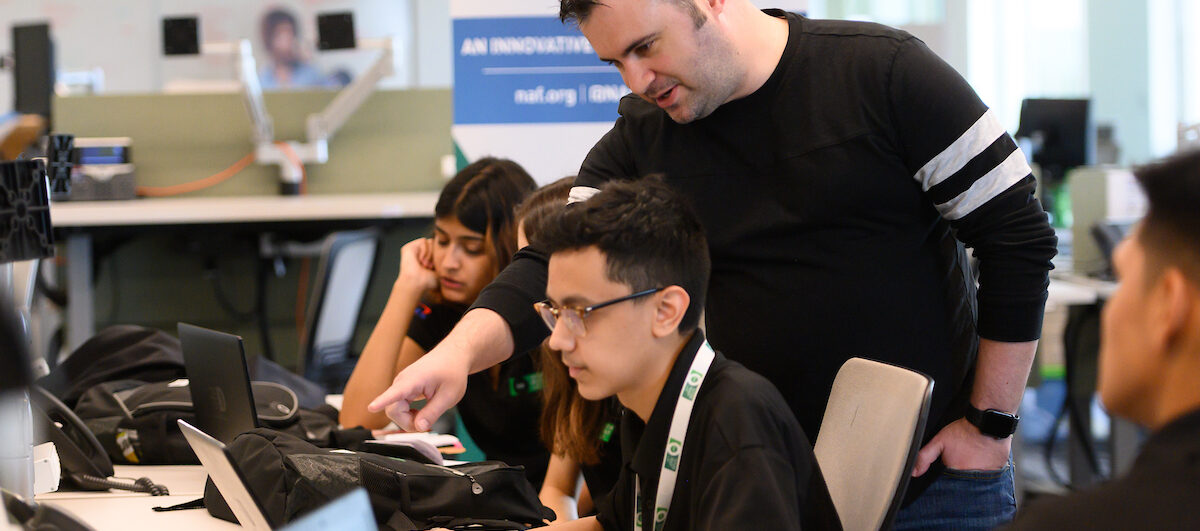
LaunchLabs are TPZ’s hands-on experiential learning modules during which students explore a variety of future-enduring industries while building durable skills. The AI & Global Health LaunchLab was designed to elevate virtual learning into a hands-on, project-based experience. Students didn’t just study AI; they utilized it. The curriculum guided them through a rigorous six-unit journey that included:
- Exploration & Research: Students investigated major global health issues and disparities, participating in simulations of both healthcare systems and challenges of the global pandemic.
- Technical Mastery: Using tools like Micro:bit microcontrollers, machine learning platforms, and environmental sensors, students learned and deployed essential AI concepts.
- User-Centered Design: To ensure their solutions met real-world needs, students created detailed user personas and affinity maps to understand community-specific pain points related to global health issues.
Transformative Partnerships with Industry Leaders
A hallmark of the NAF and TPZ approaches is connecting students directly with the professional world. Throughout the program, participants engaged with experts who provided the “real-world” context necessary for innovation and critical thinking.
- Harvard MEDScience: Students stepped into the shoes of healthcare workers at the Harvard Medical School’s MEDScience Simulation Labs. There, they explored AI-powered surgical equipment, which acted as a direct inspiration for their own projects.
- Blueprint Medicines, A Sanofi Company: Industry volunteers visited the classroom multiple times, offering professional feedback during the prototyping process and attending the final presentations to witness the students’ ideas come to life.
Student Innovation in Action
Students in the Fall cohort formed teams to tackle global challenges. Their final prototypes demonstrated a sophisticated blend of technical skill and social responsibility:
- Early Step Detection: A “breakthrough tool” designed to detect cancer cells in blood samples, via an AI-powered lens, aiming to make screening as accessible as a simple finger-prick test.
- Atmos Guard: A project focused on identifying global areas with poor air quality to help communities better allocate medical support and prevention efforts.
- Mobile Health Clinic: A self-driving vehicle prototype that uses an AI lens to navigate toward those who lack transportation to traditional medical facilities.
- Tsunami Detector: A safety device that uses pattern recognition and real-time wave data to predict early-stage tsunamis, ensuring timely alerts to save lives.
Our Vision: Scaling the Future of Career-Connected and AI-Powered Learning
This pilot serves as a foundational proof-of-concept for career-connected, AI-powered learning. By focusing on critical competencies such as problem-solving, teamwork, and STEAM agency, TPZ’s LaunchLab program helps build a skilled pipeline of not only future employees but also future leaders in healthcare and AI.
Moving forward, we are excited to define the scalability of this learning model across Massachusetts and the broader NAF network. Together, we are ensuring that the next generation is not just ready for the future—they are building it. If you’ll be at NAF Next 2026, we’d love for you to see our work in action and connect with you!
Michelle Goldberg, Senior Director of Program Partnerships, and Luke Matys, School-Based Site Lead at The Possible Zone (TPZ), will present the following session:
Wednesday, July 8th: From Challenge to Curriculum: Building Real‑World Learning with TPZ
11:30 AM-12:45 PM
Potomac Ballroom 3/4