



Top Health Science Careers for High School Students
When most people think about healthcare or health sciences careers, it nearly goes without saying that doctors and nurses are the first to spring to mind. But the health sciences ecosystem is much wider than most students realize — and it’s growing in all directions. The U.S. Bureau of Labor Statistics (BLS) projects that healthcare and social assistance will be the fastest-growing industry sector in the entire economy through 2034, driven by an aging population and rising rates of chronic physical and psychological conditions.
For today’s high school students, this signals robust opportunity across a wide health sciences career landscape – one that includes many careers connected to health sciences in ways they may not have considered. From mental health counselors who guide individuals through addiction and trauma to medical managers who keep healthcare facilities running behind the scenes. These aren’t backup plans — they’re among the fastest-growing, most stable, and most meaningful careers in America right now.
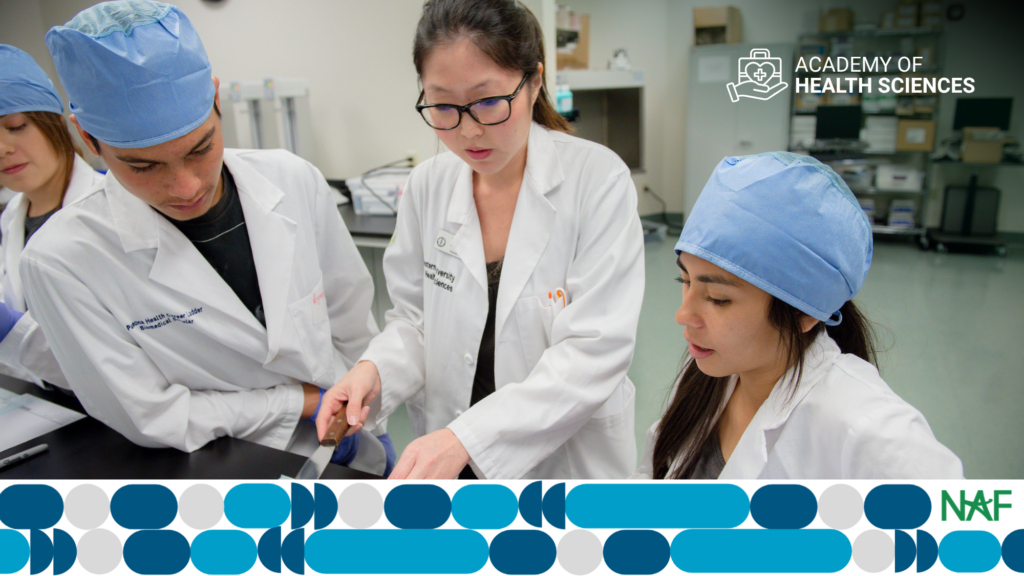
NAF Academies of Health Sciences support students in igniting their aspirations, growing professional skills, and connecting with experts in the field through career-focused curricula that encompasses anatomy and physiology, biotechnology, and global health, among other topics. Health Sciences pathway students also gain transferable skills through clinical experiences in hospitals, simulations, mentorship and forging connections with industry leaders.
The NAF Health Sciences pathway doesn’t just prepare the next generation to work in healthcare. It prepares them to lead in it. The work-based learning coursework, industry connections, and real-world projects offers a head start that most students simply don’t have. Based on the data and the overviews below, young people might find a new niche in the field worth exploring.
Physician Assistants: This growing profession requires a volume of training and an advanced degree, typically a bachelor’s degree, and then a PA master’s program. Those who pursue this path also usually gain professional experience – as an EMT or medical assistant – in between undergraduate and graduate studies. In terms of growth, the demand for physician assistants is expected to increase 20% between now and 2033, with an estimated 43,000 new jobs nationwide. PAs practice in hospitals, primary care clinics, emergency medicine, and specialty clinics. As of 2026, the median salary was reported to be $130,000 (Source: Bureau of Labor Statistics).
Nurse Practitioners: As the demand for healthcare services increases over the next decade, the demand for nurse practitioners is expected to increase by 46 percent (2023 to 2033). With a median salary of $129,210, this career is even more lucrative than physician assistants (or associates), particularly for in-demand specializations like adult care, gerontology, neonatal, pediatric, and more (Source: American Association of Nurse Practitioners). As far as training, NPs must earn a Bachelor of Science in Nursing (BSN) and pass the NCLEX-RN to become a registered nurse. After gaining clinical experience (typically 1–2 years), they pursue a Master of Science in Nursing (MSN) or Doctor of Nursing Practice (DNP), which includes advanced coursework and clinical hours. Candidates must then pass a national certification exam in their chosen specialty (family practice, pediatrics, psychiatry, etc.) and obtain state licensure.
NPs work in a wide range of settings — primary care clinics, hospitals, emergency rooms, urgent care centers, schools, private practices, and community health centers. In many states, they can practice independently without physician oversight.
Occupational Therapists: This field is a helping profession that works with individuals to improve their daily functions or occupations in activities that are meaningful to them, especially when illness, injury, disability or mental health challenges impede them. This can range from helping stroke victims regain self-sufficiency or supporting a child with sensory processing issues in the classroom. The Bureau of Labor Statistics expects the field of occupational therapy to grow by 14% by the year 2033. This position requires a master’s degree such as a Master’s of Science in Occupational Therapy (MSOT) or a Master’s in Occupational Therapy (MOT). OTs can work in hospitals and rehabilitation centers, school districts, senior living facilities and private practices.
Medical Managers: Medical managers — also referred to as healthcare administrators — plan, direct, strategize and improve upon the business operations of hospitals, clinics, nursing homes, and other large healthcare facilities. Their work spans budgeting, staff supervision, regulatory compliance, and patient care policy, serving as the bridge between clinical staff and administration. The field is growing rapidly: the U.S. Bureau of Labor Statistics projects employment to grow significantly faster than average, driven by an aging population requiring more complex care, the expansion of outpatient settings, and increasing administrative demands from evolving regulations and electronic health records. Most positions require at minimum a bachelor’s degree in health administration, public health, or a related field, though a master’s degree — such as an MHA or healthcare-focused MBA — is increasingly preferred for leadership roles. Professional certifications like the FACHE credential can strengthen career prospects.
Mental Health Counselors: The anticipated demand for mental health counselors can be traced to reduced stigma in seeking counseling, expanded accessibility via telehealth, elevated rates of anxiety, depression, and addiction post-pandemic, and increased initiatives in public schools (K-12 and higher ed alike) to provide more student support. Though the discipline of counseling and therapy is considered an art as well as a science, mental health counselors are indeed health care workers and often work in tandem with nurses, doctors, and other trained professionals to support clients and patients.
The BLS predicts that the field of professional counseling (as well as school counseling) will grow around 20% over the next decade. There are an array of professional certifications allowing one to practice as a certified counselor, but all require a master’s degree in either Social Work (MSW) or an MA, MS, or MEd in counseling.
Physical Therapy Assistants and Aides: Most physical therapy assistants (PTAs) and aides work in physical therapists’ offices or in hospitals under the supervision of licensed physical therapists to help patients recover from injuries, surgeries, and illnesses affecting their mobility and function. PTAs implement treatment plans through therapeutic exercises, applying modalities like heat, ice, or electrical stimulation, and reporting patient progress back to the supervising PT. They also can work in outpatient clinics, nursing homes, and sports facilities.
To become a PTA, candidates complete an accredited associate degree program, typically taking about two years, combining coursework in anatomy, physiology, and kinesiology with supervised clinical internships. Graduates must then pass the National Physical Therapy Examination (NPTE) and meet state licensure requirements. Physical therapist aides usually need a high school diploma or equivalent and on-the-job training.
The BLS anticipates the field will grow around 20% between now and 2034.
No matter which aspect of the career path of health sciences speaks to today’s students, the real-world experience and future-ready curricula of NAF Academies of Health Sciences are proactively shaping the next generation of pathbreaking professionals in the field.
Learn more, including how to get involved and stay connected!